
'Post-Covid world will be different from the pre-Covid world.'

Global sales made via mobile devices are expected to top $638 billion.

Patanjali Ayurved, founded in 2007 by yoga guru Ramdev, is targeting Rs 10,000-crore (Rs 100-billion) revenue in 2016-17

Ordering groceries, vegetables and daily essentials is just a WhatsApp away as billionaire Mukesh Ambani's e-commerce platform JioMart taps into the popular messaging app to scale up online business in its fight for dominance in the giant Indian retail market with Amazon and Walmart-owned Flipkart. Ambani's twin children, Akash and Isha gave a preview of the ordering at Meta's second edition of the Fuel for India event on Wednesday. A new 'tap and chat' option allows users to order groceries through WhatsApp.

Mukesh Ambani-owned RIL's JioMart is set to launch a slew of new products including financial services, electronics to airline tickets to take on the competition from upcoming rivals like the Tata Super app and other established players including PayTM, Amazon and Flipkart. This comes at a time when RIL's e-commerce revenues are set to grow by 35 per cent to $15 billion within four years and its core retail revenue is expected to grow at the same pace to $44 billion, as per a forecast by Goldman Sachs. "The Tata vs JioMart war will be the next big corporate battle to watch. "While Tata has an upper hand like in-house products and brands, RIL has the backing of global biggies like Google, Facebook and Microsoft," said head of a rating firm asking not to be quoted.
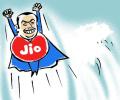
Billionaire Mukesh Ambani's Reliance Jio is India's strongest telecom brand in India, ahead of Bharti Airtel and Vodafone Idea Ltd, according to brand intelligence and data insights company TRA. TRA, formerly Trust Research Advisory, in its 'India's Most Desired Brands 2022' ranked companies according to their brand strength. Reliance Jio topped the telecom category, followed by Bharti Airtel, Vodafone Idea Ltd and BSNL.

As India's online population crosses 450 million, e-commerce ventures are trying to grab a pie of online sales estimated to hit $48 billion by 2020.

The threat may be a decade away, but it has brick-and-mortar sellers rethinking their strategies and banking on the govt to regulate online companies.

India's rank was further amplified by the collapse of the South American and Russian economies.
'For how long can investors fund loss-making companies?'

US retail major is in talks with Flipkart, Snapdeal, ShopClues and Grofers for partnership.

The fixed line broadband will offer "ultra high-definition entertainment on large screen TVs, multi-party video conferencing from your living room, voice-activated virtual assistants, virtual reality gaming, digital shopping, immersive experiences," Ambani said.

Big retailers are openly talking of plans to harness the power of big data, even reporting those in annual reports as part of a long-term strategy.

Many industry executives have said the draft e-commerce policy is being perceived as nationalistic but not overly protectionist and it is providing preference to Indian players against foreign companies. This might have an impact on investment by large players such as Walmart and Amazon in the country, said the executives. They said e-commerce was a very small portion of the retail industry and at a nascent stage and did not require heavy hammer regulations. Though the policy talks about being equally applicable to foreign and domestic players, it mentions that foreign direct investment (FDI) takes precedence over the e-commerce policy in any area of overlap.
Future group promoter Kishore Biyani's stake fell consistently across group companies since December 2019 after American retail major Amazon infused funds in a Future group promoter entity and the group companies started showing signs of financial distress due to closure of stores due to Covid-19 pandemic. As lenders take Future group companies to the bankruptcy courts to recover their dues under the Insolvency and Bankruptcy Code, the shareholders of Future group companies are staring at complete wipeout of their investments as secured lenders get top priority in any potential recovery, say lawyers. "The fate of all Future group shareholders is now sealed with them looking at a complete loss.

Recent easing of restrictions does not address the pain in the sector.

Flipkart, the e-commerce company owned by Walmart, is intensifying its efforts to achieve profitability as it is eyeing a valuation of approximately $60 billion at the time of its initial public offering (IPO), now planned in 2025-2026, instead of this year, according to people familiar with the matter. The firm might consider listing in the US or any other geography, including India. The company, which counts the likes of Amazon and Reliance's JioMart among its competitors in India's burgeoning e-commerce market, had also contemplated launching an IPO in 2022-2023.

Apart from digital advertising revenue, both companies want to reach out to the 'next billion' Indian customers. After all, around half of the 1.3 billion population is still not on the net and this represents a challenge as well as an opportunity.

Reliance Industries (RIL) has been distilling its investment strategy to meet new goals. The share of the new energy vertical - its key focus area - accounts for more than a fourth (26 per cent) of the total war chest of $6.4 billion, ploughed into acquisitions and picking up stake from 2018 to date, reveals the latest Morgan Stanley data. Nearly half the incremental investments made on deals by RIL between August 2020 and September this year ($3.3 billion) has been spent on new energy - acquiring global companies with technology and expertise.

The deal, which is expected to close in the next four to five weeks, will give exit to investors Alibaba, Abraaj Group and IFC. The parties are awaiting approval from the Competition Commission of India (CCI).
Flipkart has promoted several of its leaders into newer roles at a time when the Walmart-owned e-commerce giant has internally raised its IPO (initial public offering) valuation target to about $60 billion and aims for a US listing in 2023, according to the sources. "I am delighted to announce the promotion of some of our exemplary leaders," said Kalyan Krishnamurthy, chief executive officer, Flipkart Group, in an internal note, and which has been reviewed by Business Standard. "Each of them has been instrumental in delivering impact and creating long-term value for Flipkart.

Besides growing tech and digital enhancements, the firms are ramping up the hiring of more delivery partners and reinforcing existing Covid protocols.

Walmart, the world's largest retailer, is hoping to get more than 30,000 consumers through its e-commerce pilot project that will be launched in the first week of July.

Its success script: Investing more in local content ecosystem; growing its partnership footprint.

Make no mistake, Reliance's entry into Indian e-commerce cannot be taken lightly. It is akin to a combine of AT&T and Wal-Mart challenging Amazon on its home turf, says Shailesh Dobhal.

Jio Platforms is expected to use its 388 million mobile phone subscribers as the cornerstone of an e-commerce and digital services business to rival Amazon and Walmart's Flipkart.

The groups plan to take on well-entrenched players like Amazon, Flipkart, and Paytm by merging their offline businesses with e-commerce initiatives.

The competition which BigBasket faces now is with the big three - Amazon, Walmart, and Reliance.

In March this year, Worldline India launched Vabox (Voice Alert Box): merchants will now get instant audio alerts on the settlement of UPI (Unified Payments Interface) payments via QR codes in languages of their choice when customers check out. "They needn't worry whether the amount has been credited to their account," says Gulshan Pruthi, the firm's executive vice-president. The French payments giant will roll out 500,000 Vaboxes in the initial phase.

Union Minister of Commerce and Textiles Piyush Goyal has stirred up a hornet's nest by taking on India Inc, specifically the Tata group, which is among the companies that lobbied against the Modi government's pro-consumer draft e-commerce policies. While Goyal's comments, made at a Confederation of Indian Industry (CII) event, were streamed live on YouTube, the industry lobbying body later edited the video and subsequently withdrew the entire speech. Goyal had said the Tata group and other Indian companies often lobbied for their interest, while ignoring national interest.

Three business houses are likely to be in the final race to strike a deal with Germany's Metro AG for investing in its India unit -- Metro Cash & Carry. Industry sources in the know named Reliance, Adani Group, and Thailand's conglomerate Charoen Pokphand (CP) as potential frontrunners to acquire a partial or full stake in the Gurugram-headquartered Metro Cash & Carry, which has 31 stores and 5,000 direct employees. Around 20 companies, including strategic and private equity investors, were approached by the German chain, inviting them to bid for the Indian wholesale business, according to a source aware of the M&A developments.

Capital dumping is being used by foreign e-commerce firms to subsidise and engage in predatory pricing, oil-to-telecom conglomerate Reliance Industries (RIL) has told the Associated Chambers of Commerce and Industry of India (Assocham) in an internal document. The document alleges that this is leading to massive unemployment and financial distress among small merchants and kirana stores. It consists of various recommendations and proposed changes that deal with Press Note 2 of 2018 (PN 2), which RIL wanted Assocham to present to the government, according to sources.

Footfalls will invariably come down to a trickle even after lockdown restrictions go away, and the only way to prevent someone else from poaching your consumer is to go down to the consumer herself. Consumers will prefer products and services to be delivered to their doorstep, hygienically and safely.

Policy constraints may prevent many of the global retail giants from reaching their full potential.There are too many restrictions right now in the sector and policy makers lack clarity.

Walmart-owned Flipkart on Thursday said the company is in compliance with Indian laws, including FDI regulations, and will cooperate with the Enforcement Directorate on the notice sent to the e-commerce major. The Enforcement Directorate (ED) has issued a show cause notice of Rs 10,600 crore to Flipkart and its promoters for alleged violation of the foreign exchange law, official sources said on Thursday. When contacted, Flipkart said it is in compliance with Indian laws and regulations, including FDI regulations.

The proposed amendments to the Consumer Protection (E-Commerce) Rules, 2020, that are envisioned to protect consumer interests, may further compound the impact of multiplicity of regulations on the e-commerce sector, the Indo-American Chamber of Commerce (IACC) had told the ministry of consumer affairs. IACC, the apex bilateral chamber for Indo-US business, had told the government that the proposed amendments would increase compliance liabilities that risk severely impairing the growth of the sector.
Although Walmart-Flipkart wholesale game-plan is to target about a $150 billion market out of a total pie of $700 billion in the country, the consolidation marks the end of the multi-brand dream of the American retail giant.

PharmEasy has acquired Medlife for an undisclosed amount, the e-pharmacy unicorn said on Tuesday. The deal will make PharmEasy the largest player in the domestic online pharmacy sector, with the combined entity set to serve 2 million customers a month.

Flipkart will need $2 bn annual profit to make Walmart investment viable, which will mean yearly revenue of $100 bn
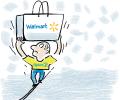
For now Walmart has said it remains optimistic about India. But that could change without prior notice, says Nivedita Mookerji.
 © 2026 Rediff.com - Advertise with us - Disclaimer - Privacy Policy - Sitemap - Feedback - About us - Terms of use - Grievances